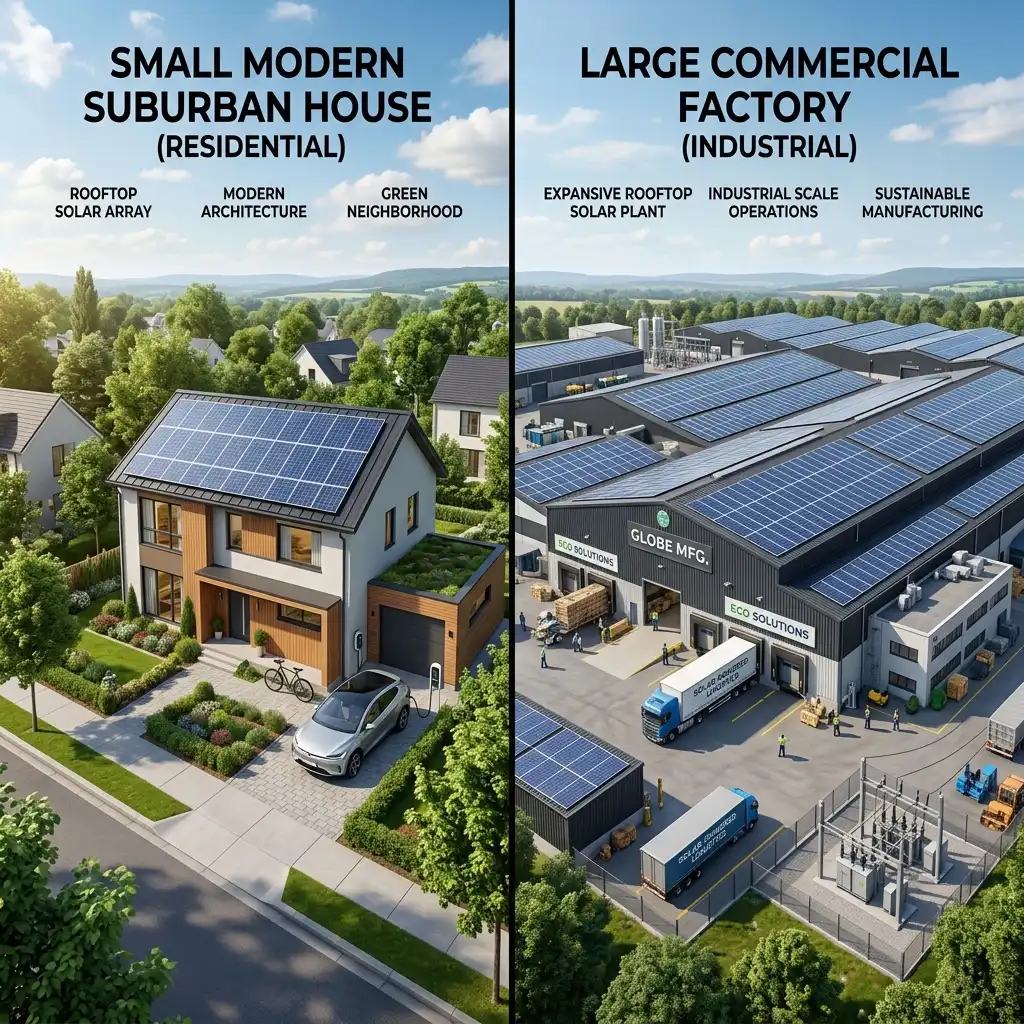
Does PM Surya Ghar Apply to Businesses?
A very common question asked by business owners is whether they can apply for the PM Surya Ghar scheme for their shops, factories, hospitals, or corporate offices.
The Short Answer is No.
The PM Surya Ghar Muft Bijli Yojana is strictly designed for Residential consumers (households) and Group Housing Societies / Resident Welfare Associations (RWAs).
Why are Commercial Properties Excluded?
The scheme's primary socio-economic goal is to alleviate the domestic electricity burden and provide up to 300 units of "Muft Bijli" (free electricity) to middle and lower-income families.
Commercial entities generally face much higher electricity tariffs and operate for profit. Therefore, the government expects businesses to invest in solar energy based purely on the incredibly rapid ROI and tax benefits, rather than relying on direct upfront capital subsidies from taxpayer money.
Subsidies for Housing Societies (RWAs)
While individual commercial businesses are entirely excluded, Group Housing Societies (GHS) and Resident Welfare Associations (RWAs) are eligible for massive subsidies under this scheme to power common areas like lifts, water pumps, and corridor lighting.
- RWA Subsidy Rate: ₹18,000 per kW.
- Maximum Capacity: Subsidized up to 500 kW (this limit is inclusive of any individual rooftop capacities already installed by residents in the society).
At a Glance: Commercial vs. Residential
| Feature | Residential (PM Surya Ghar) | Commercial / Industrial |
|---|---|---|
| Upfront Subsidy | Yes (Up to ₹78,000) | No (Zero Direct Subsidy) |
| Tax Benefits | None | Yes (40% Accelerated Depreciation) |
| Capacity Cap | Max 3kW for Subsidy | No Cap (Megawatt scale allowed) |
| Financing | Jan Samarth (7% collateral-free) | CAPEX / OPEX / RESCO Models |
Massive Financial Benefits for Commercial Solar
Even though commercial and industrial (C&I) entities do not get the ₹78,000 upfront subsidy, installing solar panels remains one of the most lucrative investments a business can make in 2026 due to three powerful mechanisms:
1. Accelerated Depreciation (AD) Tax Benefits
Businesses can claim up to 40% depreciation on the total value of the solar plant in the very first year under Section 32 of the Income Tax Act.
This drastically reduces their corporate taxable income, effectively acting as an enormous indirect financial subsidy from the government.
2. Drastic OPEX Reduction
Commercial electricity tariffs in India are notoriously high (often ranging from ₹9 to ₹12 per unit). A solar plant immediately slashes these operational costs, leading to a stunning payback period of just 2.5 to 3.5 years for most businesses.
3. No Capacity Caps (OPEX/RESCO Models)
Unlike residential users who are strictly capped at 3kW for max subsidy, commercial users can install massive Megawatt-scale systems. They can even enter into CAPEX/OPEX (RESCO) models where a third-party developer installs, owns, and maintains the system for free, and simply sells the cheap solar power back to the business at a massive discount.