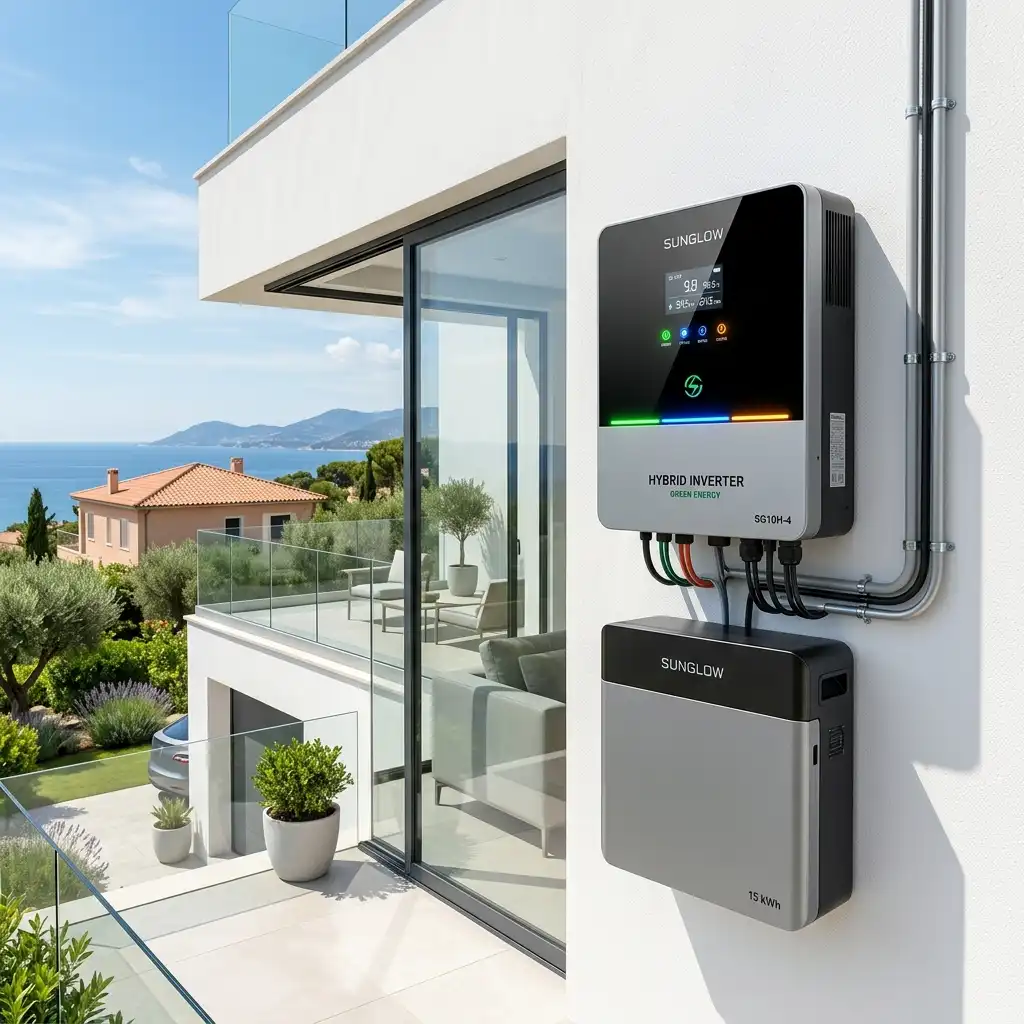
Why Your Inverter Choice is Critical
While everyone focuses on the solar panels, the solar inverter is arguably the most critical and complex component of your entire rooftop system.
Its primary job is to convert the raw Direct Current (DC) generated by the panels into the usable Alternating Current (AC) required by your household appliances and the state grid. Because inverters are complex, heat-generating electronics, they are usually the first component to fail. Choosing the right one is essential.
1. Standard String Inverters
- How they work: Multiple solar panels are wired together in a "string," and all feed their power into one large central inverter mounted on a wall.
- Pros: Highly cost-effective, easy to install, and uses proven, standard technology. This is the most common choice for PM Surya Ghar installations.
- The Major Flaw: If just one panel in the string gets shaded by a tree or water tank, the power output of the entire string instantly drops to match the worst-performing panel.
- Top Brands to Look For: Growatt, SMA, Fronius, Sungrow.
2. Premium Microinverters
- How they work: A miniature inverter is physically bolted onto the back of every single solar panel.
- Pros: Extremely high efficiency. If one panel is shaded, it does not affect the others at all. They also allow for incredible panel-level monitoring on your smartphone and are much safer (lower DC voltage on the roof).
- Cons: They are significantly more expensive upfront.
- Top Brand to Look For: Enphase Energy (the undisputed global leader in microinverters).
3. Hybrid Inverters
If you plan to use Battery Storage, a standard String or Microinverter will not work. You absolutely must buy a Hybrid Inverter.
Hybrid inverters are highly advanced "smart" devices designed to manage the extremely complex power flows between your solar panels, your battery bank, and the state grid simultaneously.
Top Brands to Look For: Luminous, Deye, Havells, Microtek.
What Size Do You Need?
A general rule of thumb is that your inverter should match your panel capacity, but a slight "oversizing" of panels is recommended. For example, if you install 3.3kW of solar panels, a standard 3kW inverter is perfectly sized, as panels rarely output their absolute maximum rated capacity in real-world temperatures.